
How to Check If a Walmart Clearance Drop Link Is a Scam
Saw a Walmart clearance or liquidation link with unbeatable prices? Learn how to inspect the domain, spot fake discount pages, verify the real offer, and protect yourself if you already paid.
Quick Answer
A Walmart clearance link may be a scam if it leads to a website that is not Walmart's official domain (walmart.com for the US, asda.com for the UK), uses extremely low prices with countdown timers, or asks for unsafe payment methods. To verify any offer, go directly to the retailer's official website or app and search for the product there. If you already entered card details or paid, contact your card issuer immediately to block the card and dispute the charge.
Fake clearance-sale links are one of the most common online shopping scams. They spread through social media posts, text messages, and online ads, often using the name of a well-known retailer like Walmart or Asda to appear trustworthy. This guide explains how these scams work, how to inspect a link safely, and what to do if you have already interacted with one.
Note: Not every clearance offer is fraudulent. Retailers do run genuine sales. The goal of this guide is to help you verify an offer through official channels before you act.
1. How fake clearance-sale links spread
Scammers distribute fake clearance links through several channels:
- Social media ads and posts — often with images of branded products at impossibly low prices.
- Text messages (SMS) — "Walmart is giving away unsold stock — claim yours."
- Email — messages that look like retailer newsletters.
- Sponsored ads on less-regulated ad networks.
- Online marketplaces and forums — links shared in comments or private messages.
These links often use the retailer's logo and branding to appear legitimate, but they lead to a completely different website.
2. Inspect the exact website domain
The single most important check is the domain in the link. Scammers rely on the fact that most people read only the brand name and not the full address.
What to look for
- Official domains:
walmart.com(US),asda.com(UK),walmart.ca(Canada). Anything else is not the official store. - Lookalike domains:
walmart-clearance.com,walmart-deals.net,asda-offer.store,walmrt.shop— these use the brand name but are different domains. - Subdomains:
walmart.com.special-offer.xyzis not a walmart.com page — the real domain is the part just before the top-level extension, read from right to left. - URL shorteners:
bit.ly/...,tinyurl.com/...hide the real destination. Use a link expander or check where it leads before clicking.
How to check without clicking
- Hover over the link (on desktop) or long-press it (on mobile) to preview the destination URL.
- Use a URL reputation checker — GoCheckAI's checker can assess a link and explain the signals it finds without you needing to visit the page.
3. A padlock (HTTPS) does not prove a site is legitimate
Many people believe a padlock icon or https:// in the address bar means a website is safe. It does not.
- HTTPS only means the connection between your browser and the website is encrypted.
- Anyone can get a free HTTPS certificate — including scammers.
- A padlock confirms encryption, not trustworthiness.
A fake clearance site can have a valid padlock and still be designed to steal your money or card details. Always combine the HTTPS check with a domain check and other signals.
4. Fake discount claims to watch for
Scam clearance pages use psychological pressure to make you act fast without thinking:
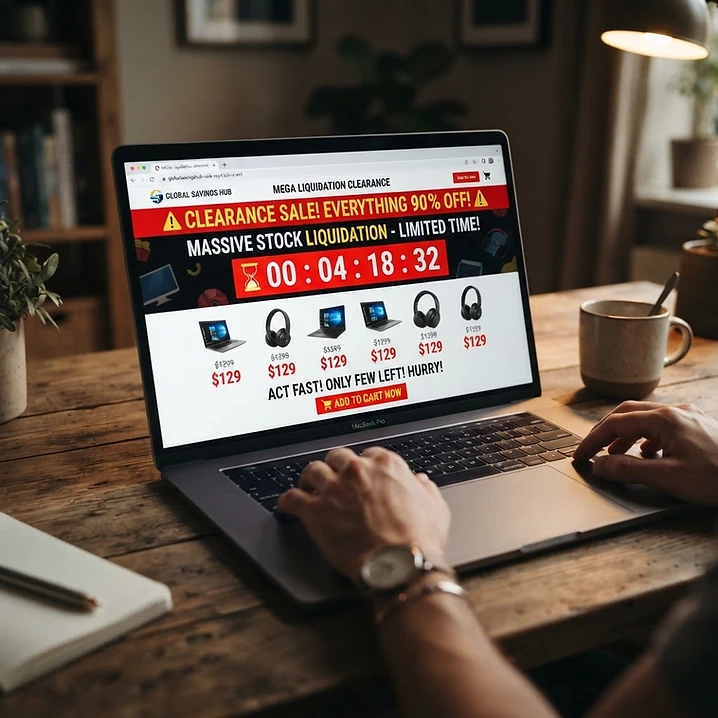
- Extremely low prices — a $800 TV for $39, a $200 item for $12. If the price is implausibly far below market value, treat it as a red flag.
- Artificial countdown timers — "Offer ends in 00:04:59" that reset every time you reload the page.
- "Only a few items left" messages — fake stock counters designed to create urgency.
- Fake warehouse liquidation claims — "Walmart is closing its warehouses and giving away unsold stock." Retailers do not give away inventory at a fraction of its value.
- Pop-ups and redirects — the page may redirect you to other fake stores or show fake "order confirmed" screens.
Genuine sales do have limited-time offers, but they do not combine all of these pressure tactics at once with prices that are far below any reasonable market value.
5. Suspicious payment methods and unsafe checkout behavior
Watch how the checkout page behaves:
- Unusual payment options — the page asks for payment by gift cards, cryptocurrency, wire transfer, or a direct bank transfer to an individual, rather than a standard card payment through a recognized processor.
- No recognized payment processor — legitimate retailers use established payment gateways. A bare card form with no familiar processor branding is a warning sign.
- Asks for more than needed — a real store asks for card details, billing address, and maybe a phone number. A scam page may ask for your card PIN, OTP, online banking login, or full card details including CVV in an insecure form.
- No order confirmation or receipt — after payment, you receive no email receipt or order number.
6. Verify the offer through official channels
The most reliable way to confirm an offer is to bypass the link entirely:
- Open the retailer's official app or website directly — type
walmart.comorasda.comyourself. - Search for the product by name or model number.
- Check the official price. If the official site does not show a similar discount, the link you received is likely fake.
- Check the retailer's official clearance or deals page — most retailers have a dedicated deals section.
If the offer exists only on an unfamiliar website and not on the retailer's official store, treat it as suspicious.
7. Check website reputation safely
Before visiting a suspicious page, you can assess its reputation without loading it:
- Use GoCheckAI's link checker to get a risk assessment and an explanation of the signals found.
- Check the domain's registration age — a very recently registered domain selling "clearance" deals is a signal, though not proof by itself (see below).
- Look for reviews or mentions of the domain from independent sources.
Is domain age a reliable scam indicator?
No — domain age is only one signal among several. A newly registered domain is worth treating with extra caution, especially for a clearance sale, but:
- Some legitimate businesses use new domains.
- Scammers sometimes buy old, expired domains to appear established.
- Domain age alone does not prove a site is fraudulent.
Combine domain age with other signals — the exact domain name, the presence of lookalike branding, the payment methods, and the price plausibility — before drawing a conclusion.
8. What to do based on what you did
If you only clicked the link
- Close the page and do not enter any information.
- Run a security scan if the page prompted you to install anything.
- Report the link to the platform where you found it (the social network or email provider).
If you entered personal details
- Watch for phishing emails or messages that may use your details to target you further.
- Be cautious of any "order confirmation" emails from unknown senders.
- Consider using a separate email address for online shopping to limit exposure.
If you entered card details
- Block your card immediately — call the number on the back of your card or use your banking app to freeze it.
- Request a replacement card.
- Dispute any unauthorized charge with your card issuer.
- Monitor your card statements for the next several weeks.
If you completed a payment
- Contact your card issuer or payment provider immediately — the faster you report, the better the chance of a chargeback.
- Ask about the chargeback or dispute process for your card type (credit cards generally offer stronger consumer protection than debit cards in many countries).
- Save all evidence — the order confirmation, the website URL, screenshots, the payment receipt, and any email communication.
- Report the fraudulent store to your country's consumer-protection or cybercrime authority.
9. Contacting your card issuer or payment provider
Always use official channels:
- Card issuer: Call the number on the back of your card or use the bank's official app. Do not use any number provided by the suspicious website.
- Payment app (UPI, PayPal, etc.): Use the in-app dispute or help center.
- Bank: Use the official fraud helpline listed on the bank's website.
10. How GoCheckAI can help
GoCheckAI helps you assess suspicious URLs before you visit them or enter any information:
- Check a clearance link to get a risk score and an explanation of the signals found, including domain and reputation signals.
- Build an action plan if you have already paid or entered details.
- Organize evidence — screenshots, URLs, transaction IDs — in a secure Evidence Vault.
GoCheckAI does not guarantee that any link is safe or unsafe, and using the platform does not guarantee prevention of fraud or recovery of funds. It is a decision-support tool to help you verify offers more confidently.
Not sure if a clearance link is real?
Paste the link into GoCheckAI's checker for a risk assessment before you enter any details.
Check a clearance linkFAQ
Are all Walmart clearance links scams?
No. Walmart and other major retailers run genuine clearance sales. The concern is links that lead to websites which are not the retailer's official domain, offer implausibly low prices, or use high-pressure tactics. Always verify the offer on the retailer's official website or app.
How can I tell if a clearance link is fake?
Check the exact domain in the link, compare the price to the official store, look for artificial countdown timers and fake stock counters, and review the payment methods. If the link leads to a domain that is not the retailer's official one, treat it as suspicious.
Does HTTPS or a padlock mean a website is safe?
No. HTTPS only means the connection is encrypted. Anyone can obtain a free HTTPS certificate, including scam websites. A padlock confirms encryption, not that the business behind the site is legitimate.
What should I do if I entered my card details on a fake store?
Block your card immediately using your banking app or by calling the number on the back of the card, request a replacement, dispute any unauthorized charge, and monitor your statements. The sooner you act, the better your chances of a successful chargeback.
How do I verify a real Walmart offer?
Open the official Walmart app or type walmart.com yourself (or asda.com in the UK), and search for the product. If the same discount does not appear on the official store, the link you received is likely fake.
Is domain age a reliable scam indicator?
Domain age is one signal among several, not proof on its own. A very new domain selling clearance deals is worth extra caution, but some legitimate businesses use new domains, and scammers sometimes buy old expired domains to appear established. Combine domain age with other signals before deciding.
Can GoCheckAI check a clearance link for me?
Yes. GoCheckAI can assess a link and explain the risk signals it finds, including domain and reputation signals. It cannot guarantee a link is completely safe or fraudulent, but it helps you make a more informed decision before you enter any details.
Conclusion
Fake clearance links exploit two things: the trust we place in well-known retailer names and the urgency of a "too good to miss" price. By checking the exact domain, understanding that HTTPS is not proof of legitimacy, verifying the offer on the official store, and acting quickly if you have already paid, you can protect yourself from most of these scams.
If you have already been affected, create an action plan to get a prioritized recovery checklist, and check any remaining suspicious links before you interact with them.
Want ongoing protection?
GoCheckAI Pro adds continuous monitoring of suspicious indicators linked to your case. Explore the plans — no guarantees, just tools to help you stay ahead.
Explore GoCheckAI Protection PlansImportant
This article is for general informational purposes only and is not legal, financial, or professional advice. GoCheckAI is an independent platform and is not affiliated with any government agency. Always report crime to official authorities in your country.
High Risk of Recovery Scam
Scam victims are often targeted again by fake “recovery agents.”
- Anyone claiming “We can recover your money for a small upfront fee” is almost certainly a scammer.
- Recovery is never guaranteed. No legitimate service charges an upfront fee to retrieve stolen funds.
- Scammers buy victim lists — expect fake “hackers”, “officials”, and “lawyers” to contact you.